Go trusted VPN
A practical guide to choosing and using a Go Trusted VPN, with tips, comparisons, and best practices.
The Go Trusted VPN landscape can be confusing. This guide explains how to assess a VPN service that you can truly trust, what to look for in features and policies, and how to use it safely in everyday online activity. Whether you’re protecting your data on public Wi-Fi, bypassing regional restrictions, or safeguarding your browsing from prying eyes, the right VPN makes a difference.

What makes a VPN “trusted”?
Security basics
A trusted VPN should offer:
- Strong encryption: AES-256 or equivalent with modern protocols.
- Secure tunneling: OpenVPN, WireGuard, or IKEv2 with secure defaults.
- Minimal attack surface: no exposed dashboards or weak endpoints.
Privacy commitments
Key privacy elements include:
- No-logs policy: the provider doesn’t store user activity or connection metadata.
- Independent audits: third-party verification of privacy claims.
- Jurisdiction: favorable data protection laws and a transparent approach to data requests.
Transparency and governance
Trustworthy services tend to publish:
- Clear terms of service and privacy policy.
- Regular security updates and incident reports.
- Public roadmaps and transparent incident timelines.
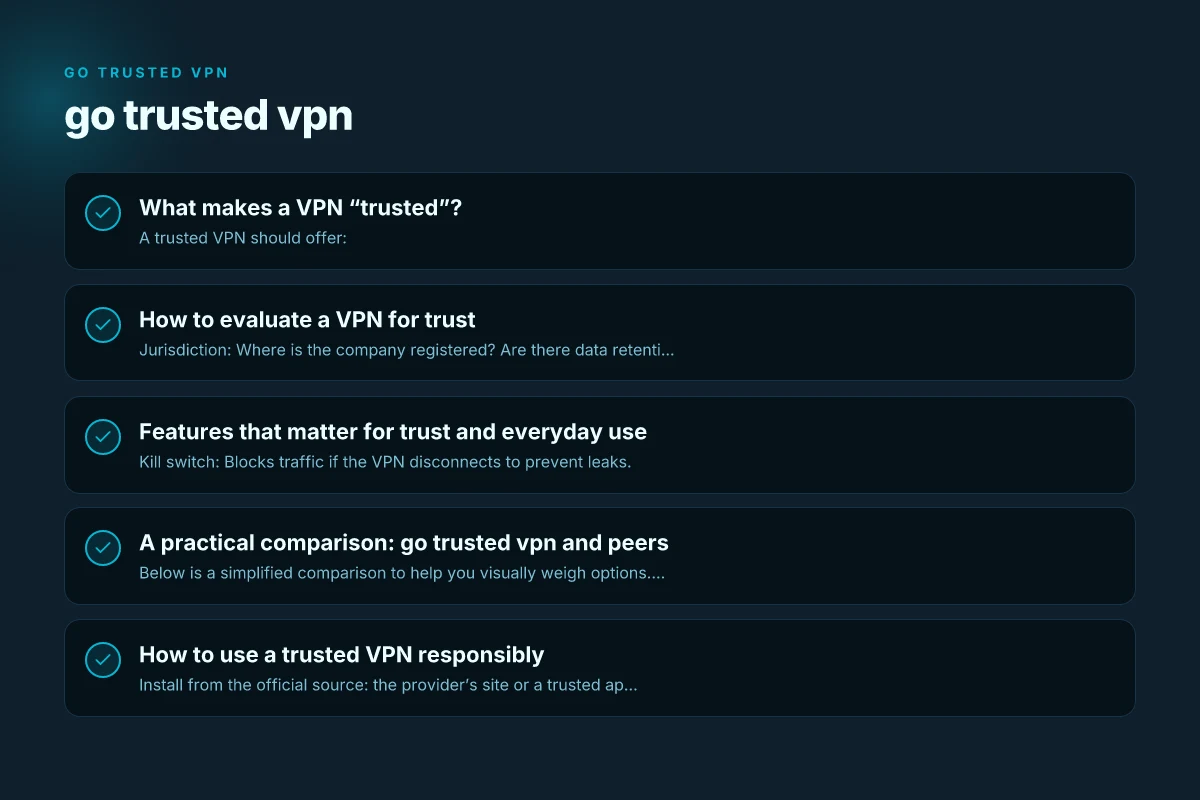
How to evaluate a VPN for trust
Legal and compliance factors
- Jurisdiction: Where is the company registered? Are there data retention laws that could compel logging?
- Lawful interception: Does the provider cooperate with government data requests or surveillance programs?
Technical safeguards
- Encryption standard: Look for AES-256 and robust key exchange.
- Protocols: WireGuard generally offers good speed and security; OpenVPN remains battle-tested.
- DNS and IP leak protection: Built-in safeguards to prevent leaks if the VPN drops.
Privacy and data handling
- Logging specifics: Do they log connection times, bandwidth, destinations, or IPs?
- Data minimization: Do they collect only what is necessary to operate the service?
- Data handling policies: How and where is data stored? Is it anonymized?
Independence and scrutiny
- Independent audits: Have privacy practices been audited by a reputable firm?
- Transparency reports: Are there regular reports about data requests or security incidents?
Features that matter for trust and everyday use
Core features that build trust
- Kill switch: Blocks traffic if the VPN disconnects to prevent leaks.
- DNS protection: Prevents DNS leaks and protects against some types of tracking.
- Multi-hop or obfuscated servers: For extra privacy in restrictive networks.
- Split tunneling: Control which apps use the VPN to optimize performance.
Performance considerations
- Server network size: More servers in diverse locations often improve reliability.
- Protocol efficiency: WireGuard usually provides faster, leaner performance.
- Bandwidth caps and throttle policies: Ensure no hidden limits on your plan.
Compatibility and ease of use
- Platform support: Windows, macOS, iOS, Android, Linux, routers.
- Simplicity: Clear onboarding, minimal configuration, sensible defaults.
- Customer support: Accessible help channels, response times, and self-serve resources.
A practical comparison: go trusted VPN and peers
Below is a simplified comparison to help you visually weigh options. Note that real features and terms can change. Always verify on the provider’s site. Free 2 surf VPN
| Feature / Factor | go trusted vpn (example) | Competitor A | Competitor B |
|---|---|---|---|
| Encryption | AES-256 + WireGuard | AES-256 + OpenVPN | AES-256 + OpenVPN |
| Privacy policy | No-logs claim, audited | No-logs, occasional audits | Partial logs, limited audits |
| Independent audit | Yes, 2023 | Yes, 2022 | No |
| Jurisdiction | Privacy-friendly country | US-based | Netherlands |
| Kill switch | Yes | Yes | No |
| DNS leak protection | Yes | Yes | Yes |
| Multi-hop / obfuscation | Optional | Not offered | Yes |
| Split tunneling | Yes | Yes | Yes |
| Tracker/data collection | Minimal telemetry | Moderate telemetry | High telemetry |
| Support channels | Email + chat | Email only | Community forums |
| Price (monthly) | Competitive | Low-cost | Premium |
What this table illustrates is not a verdict on any one provider, but a framework. When you compare options, align them with your priorities: privacy vs. price, or performance vs. transparency.
How to use a trusted VPN responsibly
Set up and first-use steps
- Install from the official source: the provider’s site or a trusted app store.
- Enable core protections immediately: kill switch and DNS leak protection.
- Choose a primary protocol: WireGuard for speed and strong security; OpenVPN if you’re in a situation with strict firewall policies.
Daily practices for privacy
- Avoid reusing credentials: use a password manager and unique credentials.
- Review app permissions: ensure the VPN app doesn’t request unnecessary data.
- Update regularly: keep the VPN client and device OS patched.
Common pitfalls to avoid
- Assuming “no logs” means zero: even with no logs, metadata can be sensitive. Read the policy carefully.
- Ignoring audits: a lack of third-party audits is a red flag for many users.
- Overlooking jurisdiction: data protection laws vary. Country of registration matters for requests.
A short guide to common questions
- Do free VPNs offer trust? Free services often monetize data or log more aggressively. They can be risky from a privacy standpoint. If you must use a free option, pair caution with a paid service for critical tasks.
- Can a VPN protect me from all threats? A VPN protects data in transit but not all end-point threats. Use it with updated devices, antivirus, and safe browsing habits.
- Will a VPN hide my activity from my employer or ISP? It hides the content of your traffic from the network operator, but it doesn’t make you invisible. Some operators may still see that you are connected to a VPN and timing patterns persist.
- Is “trusted” just marketing? Not necessarily. A combination of transparent policies, independent audits, and consistent privacy safeguards tends to indicate genuine trust.
The final take: how to choose the go trusted VPN for you
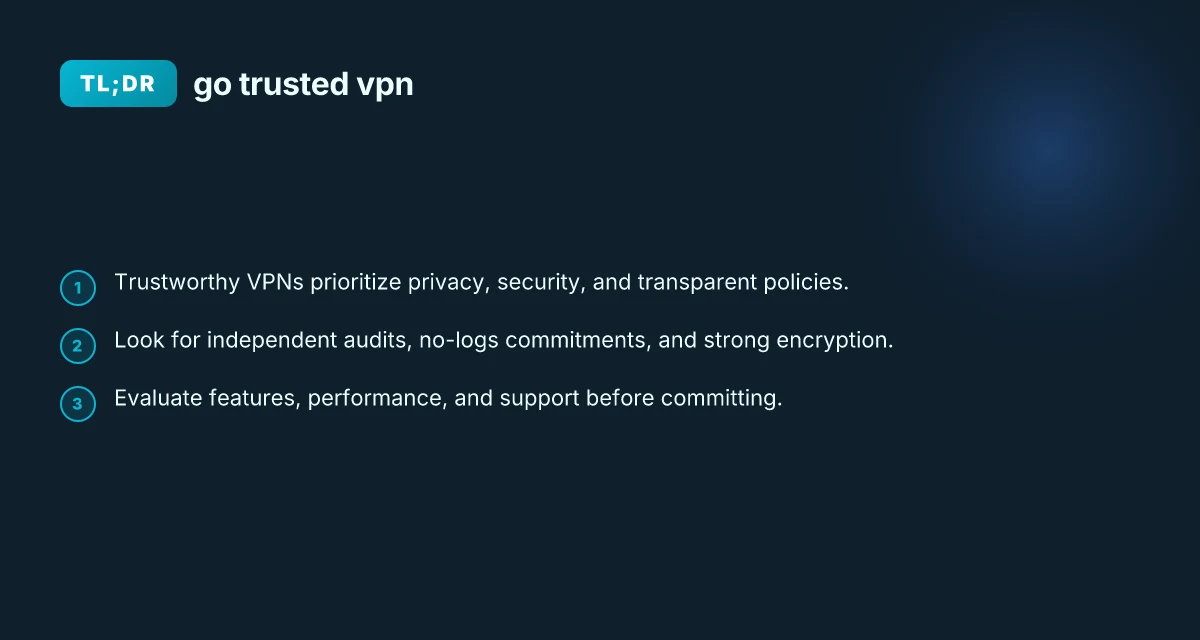
- Prioritize privacy commitments: No-logs policies and independent audits are strong signals.
- Verify security basics: encryption standards, secure protocols, and leak protection should be non-negotiable.
- Consider governance and support: jurisdiction, incident transparency, and accessible support are practical indicators of reliability.
- Test before you commit: many VPNs offer trial periods or money-back guarantees. Use them to assess speed, reliability, and compatibility with your devices.
- Read the fine print: terms, data handling statements, and user controls can reveal how much trust you should place in a provider.
Recommendation: If you’re seeking a balance of strong privacy, transparent practices, and solid performance, start with a VPN that demonstrates clear no-logs commitments, independent audits, and robust security defaults. Use the trial period to verify that the service maintains consistent speeds across your typical locations, and ensure the kill switch and DNS protections behave reliably on all your devices. Pair your choice with best practices for safe browsing and data hygiene to maximize the benefits of your go trusted vpn.
| VPN | Obfuscation | From / month | Plan | Free plan | Refund | Alipay | UnionPay | Crypto | Website opens in China | Trustpilot | |
|---|---|---|---|---|---|---|---|---|---|---|---|
 ZoogVPN | Turn on manually Shadow | $2.49/mo | 27 months: $59.99 | Yes | 7 days | ✓ | ✓ | ✓ | ✓ | Official site blocked; our special link opens (4.4 s) | 4.2/5 (195 reviews) |
 NordVPN | Turn on manually Obfuscated Servers / NordWhisper | $3.49/mo | 27 months: $94.23 | No | 30 days | ? | ✗ | ✓ | ✓ | ✗ Blocked | 4.2/5 (51,628 reviews) |
 ExpressVPN | ✓ On by default all servers | $3.00/mo | 28 months: $84 | No | 30 days | ✗ | ✗ | ✓ | ✗ | ✗ Blocked | 4.4/5 (29,706 reviews) |
 Surfshark | ✓ On by default Camouflage, with OpenVPN | See site | See site | No | 30 days | ✗ | ✗ | ✗ | ✓ | ✗ Blocked | 4.3/5 (31,823 reviews) |
 Proton VPN | Turn on manually Stealth, free plan too | $2.99/mo | 12 months: $35.88 | Yes | 30 days | ✗ | ✗ | ✗ | ✓ | ✗ Blocked | 2.1/5 (1,040 reviews) |
 Astrill VPN | Turn on manually StealthVPN / OpenWeb | $12.50/mo | 24 months: $300 | No | See site | ✗ | ✗ | ✗ | ✓ | ✗ Blocked | 1.3/5 (110 reviews) |
 Private Internet Access | Turn on manually Shadowsocks, OpenVPN only | $2.03/mo | 40 months: $81.2 | No | 30 days | ✗ | ✗ | ✗ | ✗ | ✗ Blocked | 4.2/5 (11,033 reviews) |
 CyberGhost | Turn on manually selected servers | $2.19/mo | 28 months: $61.32 | No | 45 days | ✗ | ✗ | ✗ | ✓ | ✗ Blocked | 4.0/5 (24,178 reviews) |
 PureVPN | Turn on manually switch to OpenVPN | $1.69/mo | 60 months: $101.55 | No | 31 days | ? | ? | ✗ | ✓ | ✗ Blocked | 4.4/5 (17,994 reviews) |
 AdGuard VPN | ✓ On by default TrustTunnel | $2.99/mo | 24 months: $71.76 | Yes | 30 days | ✓ | ✗ | ✓ | ✓ | Official site blocked; our special link opens (3.7 s) | 4.3/5 (290 reviews) |
 Mullvad | Turn on manually QUIC / Shadowsocks / LWO | $5.61/mo | €5/mo | No | 14 days | ✗ | ✗ | ✗ | ✓ | ✗ Blocked | 3.2/5 (192 reviews) |
 Windscribe | Turn on manually Stealth / WStunnel | $5.75/mo | 12 months: $69 | Yes | See site | ✗ | ✗ | ✗ | ✓ | ✗ Blocked | 4.7/5 (13,355 reviews) |
 StrongVPN | Turn on manually Scramble, OpenVPN TCP | See site | See site | No | 30 days | ✓ | ✗ | ✗ | ✗ | ✗ Blocked | 4.4/5 (2,695 reviews) |
 LightXtreme 闪连 | Not listed | $7.08/mo | 12 months: $84.99 | Yes | 30 days | ✓ | ✓ | ✓ | ✓ | ✓ Yes (3.5 s) | No page |
Prices checked 2026-11-10 on each vendor's pricing page (cheapest long plan, USD). Check the vendor's checkout for the final price.
Obfuscation checked 2026-11-14 on each vendor's site and help center: "on by default" = nothing to set; "turn on manually" = switch protocol or mode in settings; "not listed" = the vendor describes no obfuscation.
Payment methods checked 2026-11-10 on each vendor's payment pages: all 14 take cards and PayPal; ✗ = not listed, ? = the vendor's own pages disagree.
China access: whether the official website opens from mainland China networks (tests the website only, not the VPN connection). Last checked 2026-11-18 01:02 Beijing time.
Trustpilot score and review count checked 2026-11-10.
Henry runs the site's VPN trial and refund tests.