Lithuania: A Comprehensive Guide to Its Land, Culture, and Modern Charm
Discover Lithuania’s history, culture, travel tips, and practical insights for visitors and curiously-minded readers.
Lithuania sits at the crossroads of Northern and Eastern Europe, a country that proudly preserves its medieval roots while embracing contemporary culture. From the cobbled streets of Vilnius’s Old Town to the windswept shores of the Curonian Spit, Lithuania invites visitors to explore a landscape of rolling hills, forested parks, and Baltic sea vistas. Its history is layered, its people welcoming, and its cities compact enough to explore in a few days yet rich enough to linger longer. This guide covers what to know about Lithuania, including history, culture, travel tips, and practical insights for planning your visit or simply expanding your understanding of this Baltic nation.
Quick snapshot: what makes Lithuania unique
A brief overview
- One of the three Baltic states, alongside Latvia and Estonia.
- Official language: Lithuanian, one of the oldest living Indo-European languages.
- Capital and largest city: Vilnius, noted for its UNESCO-listed Old Town.
- Known for: medieval architecture, amber, forested landscapes, a strong basketball culture, and innovative tech scenes in cities like Vilnius and Kaunas.
- Currency: Euro (EUR) since 2015. Part of the Schengen Area.
- National symbol: Vytis (the Chaser) on the coat of arms, and the Lietuviai who celebrate with song, dance, and festival culture.
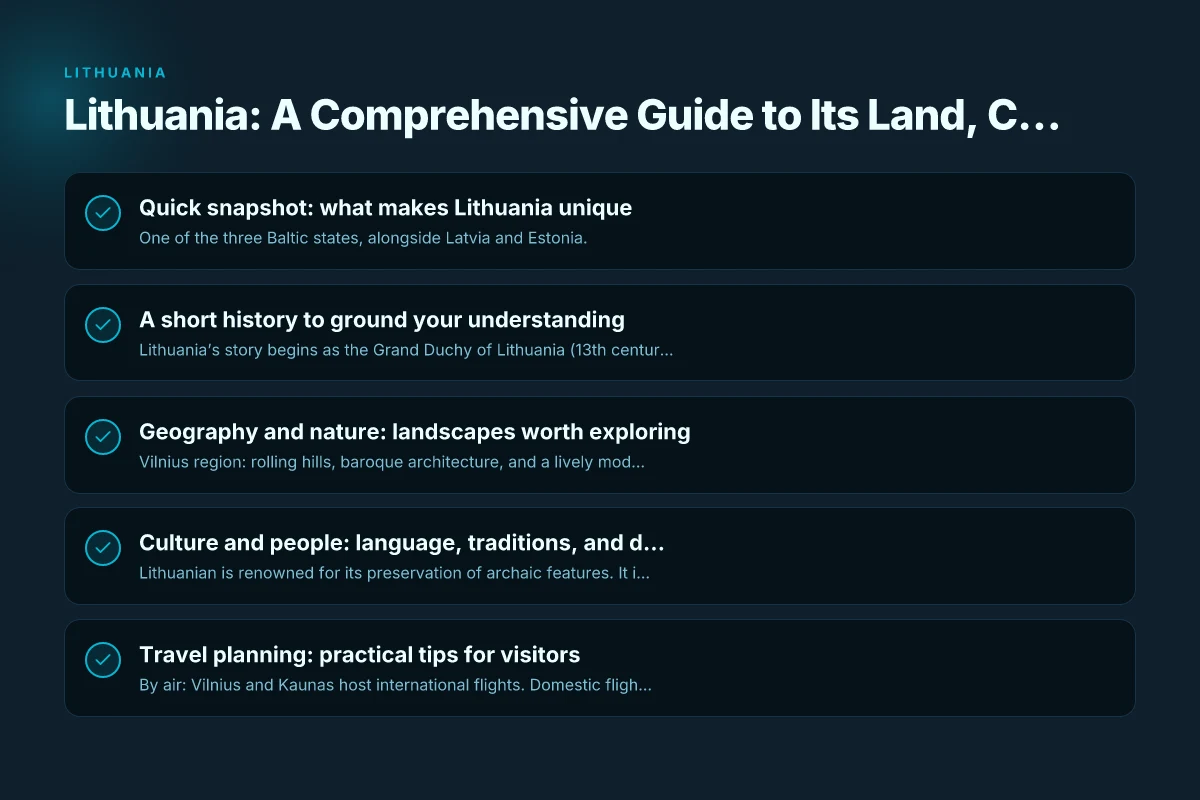
A short history to ground your understanding
From grand duchy to modern nation
Lithuania’s story begins as the Grand Duchy of Lithuania (13th century onward), a powerful medieval state that at times stretched from the Baltic Sea to parts of present-day Ukraine. In 1569, the Polish-Lithuanian Commonwealth emerged, blending cultures, religions, and architecture. In the 20th century, Lithuania declared independence in 1918, endured Soviet and Nazi occupations during World War II, and rejoined as an independent republic in 1990. Since joining the European Union and adopting the euro, Lithuania has developed a robust, knowledge-based economy while preserving its cultural heritage. This history informs its identity: resilient, inclusive, and outward-looking.
Geography and nature: landscapes worth exploring
Key regions and what to expect
- Vilnius region: rolling hills, baroque architecture, and a lively modern culture scene.
- Aukštaitija National Park: forests, lakes, and old churches. Ideal for hiking and boat trips.
- Curonian Spit: a long, narrow sand dune peninsula shared with Russia’s Kaliningrad region, offering unique dune landscapes, pine forests, and sea views.
- Zemaitija (Samogitia): rugged coastlines, traditional villages, and folklore landscapes.
- The Baltic Sea coast: wind-swept beaches, lighthouses, and seasonal seaside towns.
Bullet list: nature activities you might enjoy
- Hiking and forest bathing in Aukštaitija or Žemaitija National Parks.
- Cycle routes along lake shores or through urban greenways.
- Boat tours on Lithuania’s many lakes and rivers.
- Beach days on the Curonian Spit or along the Baltic coast.
Table: quick geography comparison (curated snapshot)
| Region | Notable feature | Sample activity | Best time to visit |
|---|---|---|---|
| Vilnius region | Medieval Old Town, baroque churches | City walks, museums, cafes | Spring to early autumn |
| Curonian Spit | Dune landscapes, UNESCO site | Beach, dune climbing, birdwatching | Summer |
| Aukštaitija NP | Lakes and pine forests | Boat trips, hiking, camping | May–September |
| Žemaitija NP | Forested hills, lakes, heritage villages | Cycling, rural hospitality experiences | late spring to autumn |
Culture and people: language, traditions, and daily life
Language and identity
- Lithuanian is renowned for its preservation of archaic features. It is often described as closest to Proto-Indo-European among living languages.
- English is widely spoken in urban areas and by younger people; Russian usage has declined since independence, though some older residents may know it.
- Folk songs (dainos) and the Song Festival tradition are integral to national identity, symbolizing unity and cultural continuity.
Art, food, and everyday life
- Cuisine highlights: cepelinai (potato dumplings stuffed with meat or cheese), šaltibarščiai (cold beet soup), kugelis (potato pudding), and various rye breads.
- Amber: Lithuania’s coast and beaches yield amber jewelry and craft items that are popular souvenirs.
- Basketball is a national pastime, with a strong community and school-level participation that feeds into a broader sporting culture.
Travel planning: practical tips for visitors
Getting there and around
- By air: Vilnius and Kaunas host international flights. Domestic flights connect major towns but rail and road travel are also effective.
- By train and bus: Lithuania has a relatively well-developed network of trains and long-distance buses. Rail travel can connect you to most major towns.
- By car: Renting a car offers flexibility to explore the countryside, especially to reach national parks and the Curonian Spit.
Staying connected and moving around
- SIM cards: Local options are affordable. Many travelers use eSIMs for seamless data access.
- Public transit: Vilnius and Kaunas have efficient bus and trolleybus networks. Trams service Vilnius city center.
- Driving tips: Be mindful of speed limits and parking rules in historic areas. Many towns have designated Old Town zones with limited traffic.
Safety, etiquette, and cultural norms
- The country is generally very safe. Petty crime is low in tourist areas, though normal precautions apply.
- Respect for local customs is appreciated. When visiting rural areas or sacred sites, dressing modestly and asking permission before entering certain spaces is wise.
- Cash is still commonly used in markets and smaller towns, though cards are widely accepted in cities and larger venues.
A practical guide to experiences: experiences that define a Lithuanian visit
- Old Town strolls in Vilnius: UNESCO-listed architecture, square corners, and a vibrant cafe scene.
- Kaunas modernist architecture: a contrast to Vilnius, reflecting interwar modernism, with a lively riverside setting.
- Trakai Castle: a fairy-tale fortress set on an island, reachable by boat or water taxi from Vilnius.
- Local markets and food experiences: try cepelinai and traditional pastries. Farmers’ markets offer fresh Baltic produce and regional specialties.
- Nature escapes: boat trips on lakes, hiking in national parks, and the unique glacier-carved landscapes of the Curonian Spit.
A quick comparison: Lithuania’s top travel themes
| Theme | Why it appeals | Best season | Quick tip |
|---|---|---|---|
| History and architecture | Medieval towns, baroque churches, and a layered past | Spring to autumn | Take a guided walking tour in Vilnius Old Town |
| Nature and outdoors | National parks, lakes, dunes, forests | Late spring to early autumn | Rent a bike or join a guided nature hike |
| Culture and cuisine | Folk traditions, music, amber, and hearty dishes | All year | Attend a local festival or open-air market |
| City life and innovation | Modern tech, student culture, vibrant nightlife | Summer | Explore startup hubs and university districts in Vilnius and Kaunas |
Practical travel quick-start guide
- When to go: late spring through early autumn balances weather with manageable crowds. Summers in coastal and dune areas can be busy but rewarding.
- How long to stay: 4–7 days lets you cover Vilnius, Kaunas, Trakai, and a Curonian Spit day trip, with optional add-ons to Aukštaitija or Žemaitija.
- Money matters: Lithuania uses the euro; ATMs are widespread in cities, but carry some cash for markets and small towns.
- Packing: comfortable walking shoes for cobblestones, layers for variable Baltic weather, and sun protection for dune and coastal days.
Final section: the recommendation
If you’re seeking a destination that feels both ancient and alive, Lithuania offers a remarkably accessible gateway to the Baltic region. Start with Vilnius to steep yourself in history and architecture, then add a side trip to Trakai for a fairy-tale fortress experience. Include a nature day in Aukštaitija or a sunrise visit to the Curonian Spit to witness dramatic dune landscapes and Baltic seascapes. Whether you’re drawn by culture, cuisine, or outdoor adventures, Lithuania rewards curiosity with warm hospitality and a sense of discovery that lingers long after you return home. Liechtenstein: a compact principality with alpine charm and modern finance
Henry runs the site's VPN trial and refund tests.