PostAbsolute.ScrollToFixed: What It Is, How It Works, and When to Use It

A comprehensive guide to postAbsolute.ScrollToFixed, its purpose, implementation tips, and practical use cases.
postAbsolute.ScrollToFixed is a pattern used in web development to keep an element in a fixed position relative to a scrollable container, rather than the entire window. This approach is especially useful when you have a long post, article, or feed within a scrollable area and you want certain UI elements, like a table of contents, a sticky navigation, or a callout, to stay visible as the user scrolls through that content. In essence, postAbsolute.ScrollToFixed lets you anchor an element to a point in the scrolling content so that its perceived position remains stable as the user scrolls.

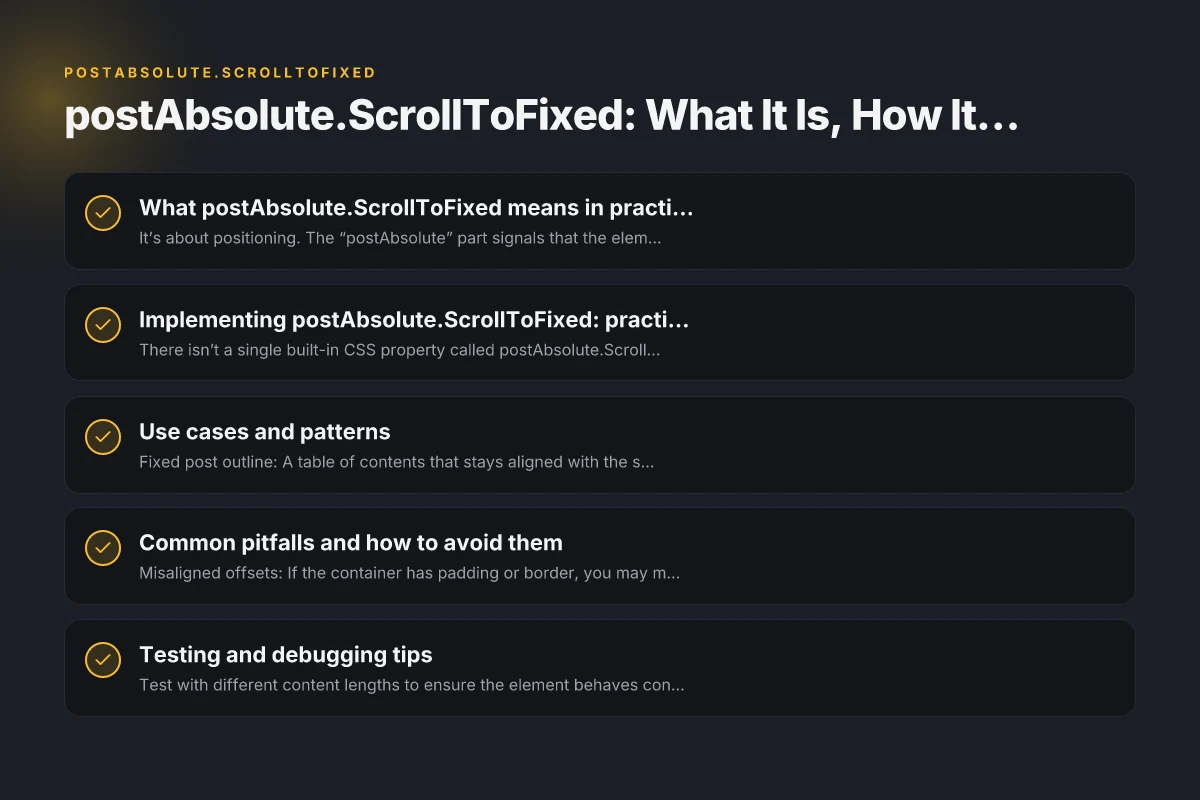
What postAbsolute.ScrollToFixed means in practice
- It’s about positioning. The “postAbsolute” part signals that the element is positioned absolutely within a post or scrollable container, not fixed to the viewport.
- It’s about scroll awareness. The “ScrollToFixed” part means the element tracks the scroll position of its container and adjusts its own position accordingly.
- It’s often used for readably large posts. Think long articles, tutorials, or documentation pages where you want a floating outline or action button to stay at a predictable spot.
How it differs from window-based fixed positioning
- Window-fixed positioning (position: fixed) anchors the element to the viewport, so it remains in the same place as you scroll the page, regardless of any container scrolling.
- PostAbsolute.ScrollToFixed anchors the element to a container’s scroll, so the element’s fixed position feels like it’s part of the content flow.
- This distinction matters when you have multiple scrollable containers, such as a content pane with its own scrollbar inside a page that also scrolls.
When to choose postAbsolute.ScrollToFixed
- You’re working with a scrollable post or article container and want a UI element to stay visible within that container.
- You need a sticky feature that should not interfere with the overall page scroll behavior.
- You want to avoid the complexity of reflowing layout on every window scroll, but still want predictable behavior inside the container.
Implementing postAbsolute.ScrollToFixed: practical approaches
There isn’t a single built-in CSS property called postAbsolute.ScrollToFixed. Instead, you implement this pattern by combining CSS positioning and JavaScript (or a library) to track the container’s scroll and adjust the child element’s position. Here are common approaches:
- Absolute positioning within a scrollable container
- The container must be position: relative or another non-static position.
- The inner element uses position: absolute with top, bottom, left, and right values adjusted as the container scrolls.
- JavaScript listens for the container’s scroll event and updates the inner element’s transform or top value to keep it visually fixed within the container.
- Sticky behavior with CSS (simpler but sometimes limited)
- position: sticky can mimic a fixed-like behavior for a child within a scrollable container.
- It’s not a perfect replacement for postAbsolute.ScrollToFixed when more complex motion or offsets are needed.
- Using a library or utility
- Some UI libraries offer “sticky within container” utilities or plugins that implement the scroll tracking and fixed positioning reliably.
A simple vanilla JavaScript example
- HTML structure:
- A scrollable container with overflow: auto.
- A header or action element inside that container.
- JavaScript logic:
- Listen to the container’s scroll event.
- Calculate the desired top offset for the inner element based on scrollTop and any container padding.
- Apply the offset via transform: translateY(.) or by setting top.
Example concept (high level, not production-ready):
- const container = document.querySelector('.post-container');
- const floatEl = container.querySelector('.post-floating');
- container.addEventListener('scroll', () => {
- const offset = Math.min(0, container.scrollTop - someThreshold);
- floatEl.style.transform =
translateY(${offset}px); - });
Accessibility considerations
- Ensure the fixed element remains reachable with keyboard navigation when it’s within a scrollable container.
- If the element is interactive, maintain proper focus management and ensure it’s not obscured or moved in a way that surprises assistive technologies.
- Provide meaningful ARIA roles and labels if the element serves as navigation or a control.
Performance tips
- Debounce or throttle the scroll handler to avoid excessive updates.
- Prefer CSS transform to top adjustments for smoother animations and better performance.
- Consider using requestAnimationFrame to batch updates with the browser’s render cycle.
Use cases and patterns
- Fixed post outline: A table of contents that stays aligned with the section of the post currently in view.
- In-post actions: Sharing buttons, call-to-action banners, or notes that remain visible as the reader scrolls.
- Toolbars within a reader: A formatting toolbar that stays visible for the portion of text the reader is currently reading.
- Side widgets within a long post: A related links panel that remains in view as the user scrolls through the article.
Comparison: sticky within container vs window fixed
| Behavior | Scroll container | Window | Typical use | Pros | Cons |
|---|---|---|---|---|---|
| Fixed within container | Yes | No | In-post outlines, container-bound actions | Keeps UI aligned with content; intuitive for long posts | More complex to implement; needs careful offset management |
| Fixed to window | No (container scroll does not affect) | Yes | Global headers, persistent site chrome | Simple; consistent across content | May obscure content; not ideal for multi-scroll areas |
| Pure CSS sticky | Yes (limited) | No | Simple in-flow sticky elements | Easy to implement; no JS required | Not flexible for complex offsets or dynamic content |
| JS-based postAbsolute.ScrollToFixed | Yes | No | In-post floating UI that tracks container | Precise control; flexible behavior | Higher implementation complexity; requires careful performance handling |
Common pitfalls and how to avoid them
- Misaligned offsets: If the container has padding or border, you may miscalculate the desired position. Always account for container padding, border, and any transform ancestors.
- Jumpiness on scroll: Use requestAnimationFrame or a throttled handler to prevent jittery movement.
- Conflicting with sticky behavior: If you mix CSS position: sticky with your JavaScript adjustments, results can be inconsistent. Decide on one approach per element.
- Overscroll artifacts: When the element reaches the top or bottom bounds of the container, ensure it doesn’t overlap or disappear. Clamp values carefully.
- Responsive issues: As container height and content change, recalculate positions on resize or content load.
Testing and debugging tips
- Test with different content lengths to ensure the element behaves consistently.
- Check on multiple devices and browsers. Some older browsers handle transforms differently.
- Use visual guides (temporary borders) during debugging to confirm the element’s position relative to the container.
- Validate accessibility by tabbing through the page and verifying focus order remains logical.
When to avoid postAbsolute.ScrollToFixed
- If you don’t have a scrollable container and you simply need a window-fixed element, use position: fixed on the viewport.
- If the element’s position needs to be perfectly the same across all devices with minimal custom logic, consider CSS sticky or a well-supported library solution.
- If the behavior is overly complex and introduces performance concerns, re-evaluate whether a simpler UX pattern could suffice.
Best practices and recommendations
- Start with the simplest solution: CSS sticky if it fits the use case.
- If you need precise control inside a container, implement a lightweight JS solution that updates transform or top on scroll events.
- Debounce/throttle and use RAF for efficient updates.
- Keep a clear separation of concerns: layout (HTML/CSS), behavior (JS), accessibility (ARIA and semantics).
- Document the behavior for future maintainers so the intent and calculations remain clear.
Final recommendation
If your goal is to keep a UI element visible within a long post or scrollable article region, consider starting with CSS position: sticky for straightforward cases. If your design requires the element to remain fixed relative to the post content itself inside a scrollable container, a postAbsolute.ScrollToFixed approach, implemented with a restrained, performance-conscious JavaScript solution, can deliver the precise behavior you need. Always test across devices, guard accessibility, and tailor the implementation to the container’s layout and content dynamics.
Naomi writes about VPN apps, browsers and privacy settings.