PreAbsolute.ScrollToFixed: A Practical Guide for Web Layouts and Sticky Elements
Explore preAbsolute.ScrollToFixed, its purpose, usage, and how to implement it for robust fixed-position behavior.
The preAbsolute.ScrollToFixed technique is a targeted approach for controlling how elements behave when you want them to stay fixed in the viewport, even as the rest of the page scrolls. It sits between traditional CSS position: fixed and more dynamic position: sticky behaviors, offering predictable results in complex layouts. This article breaks down what preAbsolute.ScrollToFixed is, how it differs from other fixed-position strategies, and how to implement it effectively in real-world projects.

What is preAbsolute.ScrollToFixed?
- A naming convention used in some libraries or codebases to describe a strategy that positions an element relative to the page flow, but fixes its position just before a particular absolute context is applied.
- It aims to combine the predictability of fixed positioning with the flexibility of absolute layouts, ensuring an element remains visible in the viewport while the rest of the content scrolls.
- It can be implemented with JavaScript to calculate offsets, or with careful CSS stacking and positioning rules depending on the framework in use.
Key differences from standard fixed and sticky:
- Standard fixed (position: fixed) keeps the element fixed relative to the viewport at all times, ignoring scrolling context.
- position: sticky attaches to the scroll container and may switch between relative and fixed as you scroll past thresholds.
- preAbsolute.ScrollToFixed seeks a middle ground by controlling when and how the element fixes itself, often in response to layout shifts or dynamic content changes.
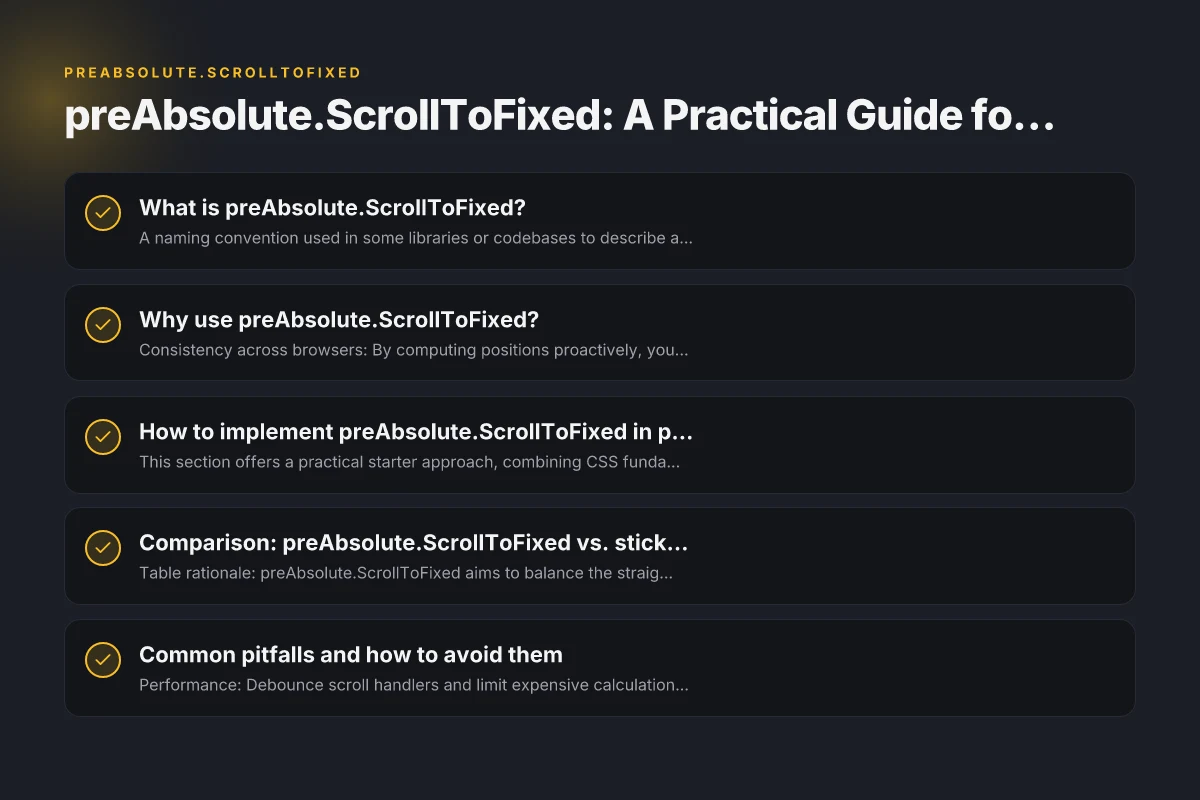
Why use preAbsolute.ScrollToFixed?
- Consistency across browsers: By computing positions proactively, you can reduce jitter and unexpected jumps during scroll, especially in complex layouts with nested containers.
- Responsiveness: It can respond to resize events and content changes without relying solely on CSS interactions.
- Complex UI patterns: Useful in dashboards, editors, or portals where headers, toolbars, or side widgets must stay visible without breaking page structure.
Considerations when choosing this approach:
- Browser support: Modern browsers handle fixed and absolute positioning well, but scripts that manage offsets must be tested across devices.
- Performance: Frequent scroll calculations can impact performance if not debounced or optimized.
- Complexity: It adds a layer of logic that may complicate debugging and maintenance.
How to implement preAbsolute.ScrollToFixed in practice
This section offers a practical starter approach, combining CSS fundamentals with a small amount of JavaScript to manage the "pre-absolute" behavior.
Setup: HTML structure
- A scrolling container or the main document body.
- A target element that you want to fix relative to the viewport under certain conditions.
- A spacer or placeholder element if needed to preserve layout flow when the target becomes fixed.
Example layout considerations: PostUnfixed.ScrollToFixed: A Practical Guide for Fixed Elements on Scroll
- The target could be a header, a toolbar, or a floating action button that needs to stay visible.
- The placeholder helps avoid content jumps when the target switches between fixed and non-fixed states.
CSS: positioning basics
- Use a combination of position: absolute/relative and position: fixed depending on the state.
- Ensure z-index is high enough to stay above other content.
- Use transform: translateZ(0) or will-change for smoother rendering if needed.
Suggested CSS skeleton: -.target { position: absolute. Top: 0. Left: 0. Width: 100%. Transition: transform 0.2s ease; } -.fixed { position: fixed. Top: 0. Left: 0. Right: 0; }
JavaScript: core logic
- Detect scroll position and determine when the element should fix itself.
- Compute the appropriate offset based on the target’s container, sticky thresholds, or other dynamic factors.
- Toggle a fixed state and apply the corresponding CSS class or inline styles.
- Debounce or throttle scroll handling to improve performance.
- Handle resize events to recalculate positions.
A minimal outline:
- On scroll:
- If window.scrollY exceeds a threshold, add the fixed class and adjust top offset based on any sticky header height or container offset.
- Otherwise, remove the fixed class and restore the element to its original position.
- On resize:
- Recalculate thresholds and offsets to adapt to new viewport sizes.
Practical code sketch (conceptual)
- Note: Adjust selectors and logic to fit your markup and framework.
- This is a starting point and may require adaptation for your project.
Code snippet outline:
- var target = document.querySelector('.preAbsolute-scroll-target');
- var placeholder = document.querySelector('.preAbsolute-placeholder');
- var fixedClass = 'preAbsolute-fixed';
- function updatePosition() {
- var scrollY = window.scrollY;
- var threshold = computeThreshold(); // depends on layout
- if (scrollY > threshold) {
- if (!target.classList.contains(fixedClass)) {
- placeholder.style.height = target.offsetHeight + 'px';
- target.classList.add(fixedClass);
- target.style.top = computeTopOffset() + 'px';
- }
- } else {
- if (target.classList.contains(fixedClass)) {
- placeholder.style.height = 0;
- target.classList.remove(fixedClass);
- target.style.top = '';
- }
- }
- window.addEventListener('scroll', throttle(updatePosition, 16));
- window.addEventListener('resize', throttle(updatePosition, 100));
Testing and debugging
- Verify behavior across scroll ranges and viewport sizes.
- Check for content jumps when toggling fixed state.
- Ensure compatibility with other fixed/sticky elements on the page.
- Confirm that keyboard and accessibility behavior remains intact.
Comparison: preAbsolute.ScrollToFixed vs. sticky vs. fixed
| Strategy | Behavior | Pros | Cons |
|---|---|---|---|
| preAbsolute.ScrollToFixed | Element becomes fixed under controlled conditions, often with a placeholder and computed offsets | Predictable under dynamic layouts; reduces jitter; customizable thresholds | More code to maintain; potential edge cases with complex nesting; needs careful testing |
| fixed (CSS) | Always fixed relative to viewport | Simple, reliable for simple layouts | Can overlap content; not responsive to container context |
| sticky (CSS) | Sticks within its scroll container after crossing a threshold | Natural scrolling feel; no JS required for basic use | Not suitable for complex nesting or precise viewport-relative fixes; limited cross-browser quirks |
Table rationale: preAbsolute.ScrollToFixed aims to balance the straightforwardness of CSS positioning with the need for dynamic control in advanced layouts. It’s not always necessary, but in projects with intricate scrolling regions, it can provide a predictable compromise. PostFixed.ScrollToFixed: A Practical Guide for Sticky Elements and Smooth Scrolling
Common pitfalls and how to avoid them
- Performance: Debounce scroll handlers and limit expensive calculations. Use requestAnimationFrame for smoother updates when possible.
- Layout shifts: Use a placeholder element to avoid content jumps when the target toggles between states.
- Responsive edge cases: Recalculate offsets on resize and consider orientation changes on mobile.
- Accessibility: Ensure focus order remains logical and that the element’s behavior does not trap focus or hinder keyboard navigation.
When to choose preAbsolute.ScrollToFixed
- You’re building interfaces with multiple scrolling panes or nested containers where a toolbar or widget must stay visible without disrupting the layout.
- You need precise control over when an element becomes fixed, beyond what CSS sticky can reliably offer.
- You’re dealing with dynamic content heights (e.g., accordions, collapsible panels) that affect how and when fixed positioning should apply.
When in doubt, prototype small: start with a single fixed element in a simple container, implement the preAbsolute ScrollToFixed logic, and test across devices. If the behavior holds steady, gradually apply it to more elements.
Final recommendations
- Start with a clear design rule: when should the element fix itself, and what offsets are required?
- Implement a lightweight JavaScript layer that calculates offsets and toggles a fixed class, with careful event handling for scroll and resize.
- Use a placeholder to preserve layout flow and prevent content jumps.
- Optimize for performance by removing unnecessary recalculations and leveraging throttling or debouncing.
- Test across browsers, devices, and content states to ensure consistent behavior.
If you’re ready to implement preAbsolute.ScrollToFixed in your project, begin by identifying the element that needs stable viewport visibility, define the threshold logic based on your layout, and build a small, focused script to manage the state transitions. With thoughtful design and robust testing, preAbsolute.ScrollToFixed can deliver a reliable, responsive, and visually consistent user experience.
Naomi writes about VPN apps, browsers and privacy settings.